

Trillions of dollars. Millions of participants. An endless, high-speed collision of bids and asks. From the outside, the financial market looks like absolute, unmitigated chaos.
The industry loves it that way. The thicker the jargon and the more intimidating the mechanics, the easier it is to convince you that you aren’t smart enough to manage your own capital. They want you to think it’s high-level physics.
But underneath the noise, the entire global market is built on a simple foundation. You don’t need a finance degree to survive it, but you do need to understand the bare-metal mechanics of what you are actually buying—and more importantly, which game you are sitting down to play before you put your money on the table.
Financial Instruments Are Legal Time Machines
The financial market is an ecosystem designed for one primary function: the flow of “Capital”, seamlessly moving it between millions of participants. To achieve the movement of capital, certain “tools” are needed, we call them the “Financial Instruments”. At its core, a financial instrument is a contract between 2 parties, legally binding on both parties. When you take a loan, the Loan Agreement is the contract. Every time you buy or sell a stock, your broker issues a Contract Note - the receipt that proves the transaction with your capital.
Why do these financial instruments exist? The purpose of the financial instruments is somewhat magical. It allows you to “move” your capital through time. Broadly speaking, these contracts allow you to do four things:
Travel to the Future (Investing/Saving): You take the purchasing power you have today, lock it inside a contract, and teleport it years down the road so your future self can leverage it.
Borrow from Tomorrow (Loans/Credit): You summon purchasing power from your future self (who will eventually be footing the bill) to fund an immediate objective right this second.
Transfer the Target (Insurance): You pay a small, regular fee to shift the massive financial burden of a potential disaster off your own shoulders and onto an institution.
Hedge Your Bets (Derivatives): You sign a contract to lock in a future price today, protecting yourself from unpredictable real-world chaos—like a drought randomly skyrocketing the cost of wheat.
Every time you buy a stock, sign a mortgage, pay a premium, or lock in a futures contract, you are stepping into one of these machines.
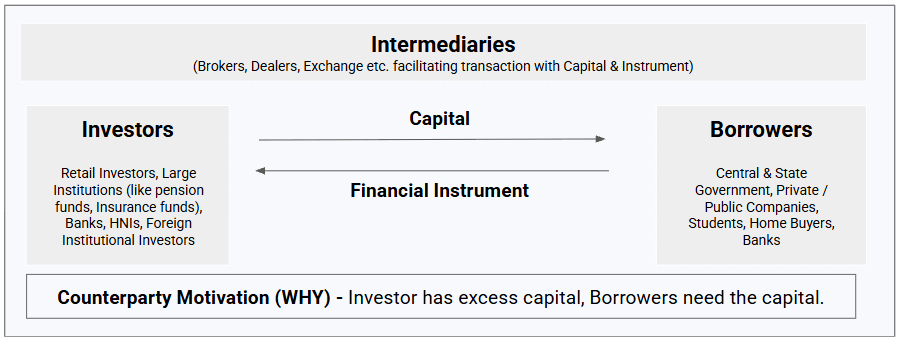
The WHO. The participants of the financial markets are the lenders and the borrowers of Capital. The market brings together Investors (those who have capital to lend, e.g. Institutional Investors, Retail Investors, banks, Asset Management Companies) and Borrowers (those who need capital to use, e.g. Governments, Companies). The Middlemen facilitate the seamless handover of “Capital” (e.g. Brokers, Exchanges, Clearing House etc) by helping in the search, matching investors to borrowers, holding the asset (and such services) based on the rules of the market.
In a nutshell, the financial markets can be visualised as below:
The Three Existential Questions of the Market
The beauty of the financial ecosystem is that there isn’t a single “right” way for everyone to participate. The market doesn’t care about your background; it only cares about your belief system. Your actions will be driven entirely by what you believe to be true. In my mind, there are 3 existential questions that define the philosophy of a market participant.
Question 1: Is the market actually efficient? If you believe the market is efficient, you believe that the price of every stock is exactly correct based on all available public information. That means there are no “hidden bargains.” If this is true, a monkey throwing darts at a newspaper would theoretically perform just as well as a highly paid stock picker / fund manager over the long run. If you hold this belief, your logical move is to buy a little bit of everything (like an Index Fund) and sit back.
But there are counterarguments. Humans aren’t robots. We are driven by deeply emotional forces like fear and greed. They sell when prices are too low or buy when they are off the charts. If you believe human emotion creates these inefficiencies, you might believe you can actively find and exploit underpriced assets.
Question 2: Are you playing a zero-sum or positive-sum game? The reason why you transact determines the game you are playing.
If you are buying for the long term, you are playing a positive-sum game. Through innovation and efficiency, companies create new value over time. The pie gets bigger, meaning both the buyer and the seller can ultimately win.
If you are actively trying to “beat the market,” you are sitting down at a poker table. This is a zero-sum game. If there is ₹500 on the table, the only way for you to walk away with extra cash is if someone else loses theirs.
But there is a crucial reality check to factor into your beliefs: because it costs money to transact, hyper-active trading is actually a negative-sum game. Every time you hit “buy” or “sell,” middlemen (brokers, exchanges, taxmen) take a tiny cut. If you trade a stock back and forth constantly, the value of the stock might not change at all, but your balance will shrink simply from the friction of the system.
Question 3: Are you an Investor, a Speculator, or a Trader? Ultimately, your answers to the first two questions, and your relationship with time, will define your identity in the market.
The Investor: Time is their greatest ally. They don’t try to outsmart the daily noise. They simply want to move their wealth from the present to the future, relying on patience and the positive-sum growth of the market.
The Speculator: They operate on a medium-term timeline. They firmly believe the market is inefficient and play a zero-sum game, using superior insights to spot mispriced assets and extract profit.
The Trader: A trader is like a surfer. They don’t care about the molecular structure of the water (the underlying value of the company); they just want to catch the momentum of a wave and get off before it crashes. They play a high-frequency, short-term game heavily reliant on strict risk management to survive.
A healthy market needs all three players. Investors bring the capital, traders bring the liquidity (so you can buy or sell instantly), and speculators take on the heavy risks to fund unproven ventures.
The question isn’t which one is best. The question is: Which one are you?
The Market’s Three-Tiered Plumbing System
Now that you know what instruments you are using and what game you are playing, you need to know who else is in the room. The financial ecosystem operates on a strict three-tier system based on what each participant brings to the table.
The Buy Side: These are the customers. They bring the capital to the market and pay for services to manage it. This includes everyday retail investors, massive corporate pension funds, aggressive speculators, the traders.
The Sell Side: These are the creators and facilitators, the investment banks, research analysts, and brokers. They pitch the ideas, create the financial products, and execute the trades for the Buy Side, taking their fee along the way.
The Market Infrastructure: You can think of them as the neutral plumbers of the system. As a retail investor, you don’t need to know the exact engineering of the pipes; you just need to know they won’t leak.
The Exchange: The actual venue where buyers and sellers are matched.
The Clearing House: The muscular bouncer that guarantees the trade. If a buyer or seller defaults, the clearing house steps in to complete the transaction, creating the ultimate foundation of trust.
The Depository: Your digital bank vault, where the electronic ledgers are updated and your shares safely sit.
Echoes From the Arena: It All Started Under a Tree
It is easy to get lost in the modern plumbing of fiber-optic cables, clearing houses, and algorithmic supercomputers. But it is vital to remember that this entire massive system was literally rooted in nature.
In 1792, after a bout of unregulated market chaos, 24 prominent stockbrokers gathered under the shade of a buttonwood tree outside 68 Wall Street. They signed a simple, two-sentence document promising to only deal with each other at a fixed commission rate. That little outdoor club eventually evolved into the New York Stock Exchange.
Half a century later, in the 1850s, India’s capital markets started in a similar way. A group of stockbrokers began gathering under a massive Banyan tree in front of Bombay’s Town Hall to negotiate shares. As the city’s commercial ventures expanded, the crowd grew, and they literally had to move around to find larger clusters of foliage to accommodate the chaos. By 1875, they moved indoors to Dalal Street and formalized into the Bombay Stock Exchange (BSE)—the oldest stock market in Asia.
Even the wildest market swings are deeply human at their core. During the 1860s, the American Civil War choked off the US cotton supply to Europe. An incredibly astute Indian broker named Premchand Roychand realized this global supply chain disruption meant Europe would desperately need Indian cotton. He funnelled massive capital into local shipping and infrastructure, triggering India’s first spectacular bull run.
It’s a perfect reminder that behind all the intimidating infrastructure, markets are simply human beings reacting to the world, negotiating in a shared space.
Conclusion: Know Your Identity
The financial market’s only real job is to move capital through time. It achieves this through legally binding instruments that allow you to invest, borrow, transfer risk, or hedge bets. The ecosystem is massive, and macroeconomic shockwaves taking place thousands of miles away will always dictate the tides.
But to survive it, your job isn’t to outsmart the system or predict the future. Your job is to define your own beliefs. Decide if you are an investor baking a pie for the long term, or a trader playing a zero-sum game at the poker table. Understand the friction that eats your capital. Figure out exactly who you are, stick to your philosophy, and let the market do the rest.
Want to dive deeper into these concepts?
I’ve recorded a comprehensive, hour-long video episode that explores all of these topics in much greater detail, and it is completely free as part of my ongoing course. Click here to watch the full deep-dive on YouTube and continue your learning journey: