

Surviving "Mr. Market"
Picture this: You’re sitting across the table from a seemingly helpful banker. Or maybe you’re cornered in your own living room by that well-meaning uncle who drops by now and then. They have successfully managed to fade your brain with a “lifetime opportunity ” of an investment, floating in a sea of intimidating jargon. Words like “liquidity,” “alpha,” and “asset class” are flying through the air. You are politely nodding, secretly wondering if it’s too early to fake an important phone call.
We have all been there! The financial industry loves to hide behind complex vocabulary, making us feel like managing our wealth requires a PhD in quantum physics. But here is the comforting truth: it is mostly a smokescreen.
The legendary investor Ben Graham had a brilliant way of simplifying. He said we should think of the financial world as a capricious business partner named “Mr. Market.”
Mr. Market is, to put it mildly, a guy with some intense mood swings. Some days he wakes up wildly optimistic and will gladly pay a premium for absolutely anything you’re selling. On other days, he is deeply pessimistic, convinced the sky is falling. He wants to sell his portfolio for peanuts. The secret to surviving him is realizing that his prices reflect his feelings, not the actual, intrinsic value of the asset.
Once you realize that the market is driven by everyday human emotions and basic self-interest, the intimidation factor melts away. Because whether you are buying a thousand shares of Airtel or haggling over a slightly rusty vintage bicycle on OLX / eBay, the underlying structural DNA of the transaction remains the same.
X-Raying the Deal (No Finance Degree Required)
Finance loves its jargon. But if we look closely, every single transaction - from buying a morning coffee to acquiring a new company - is built on seven building blocks.
Imagine you are scrolling online and spot the perfect, slightly dusty vintage bicycle on eBay / OLX. Let’s run this mundane trade through our 7-step X-ray:
The Who (Counterparties): They are the buyer and the seller. In this case, it’s you (a buyer with a need for a cool bike) and a guy named Leo (a seller who needs some space in his garage).
The What (Object of Exchange): The physical asset (the bicycle) being swapped for the consideration (your hard-earned Rs10,000).
The Why (Motivation): Here is the magical engine of every market: mutual disagreement on value. You want that bike way more than you want your Rs10,000. Leo wants Rs10,000 way more than he wants a bike gathering dust. This mutual self-interest is what makes the trade happen!
The How (Mechanism): Dave originally listed the bike for Rs15000 (the offer). You messaged him offering Rs10000, and he said yes (the acceptance). That messy little dance of haggling? Finance folks call that “price discovery.”
The Where (Infrastructure): Where does the swap happen? You meet Dave at a local grocery store parking lot (the physical settlement), and you pay him via UPI, which digitally records the transfer (the ledger).
The Rulebook (Enforcement): There is a social contract and legal framework at play. If you grab the handlebars and pedal away without paying him, Leo can call the police. The rules keep everyone playing nice.
The Friction (Hidden Costs): This is the leaky faucet of trading. Your friction includes the Rs100 in fuel you used driving to the meetup spot.
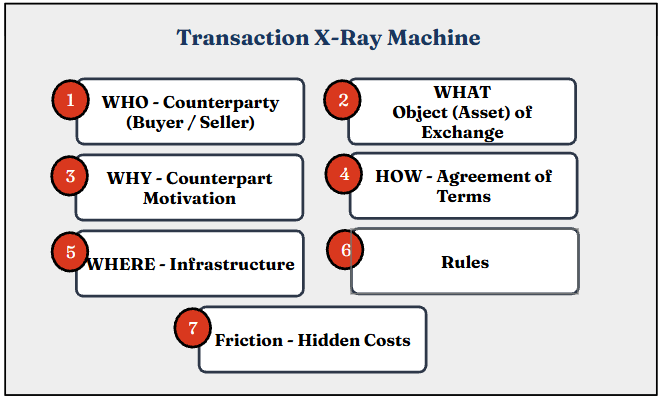
And just like that, you have deconstructed a market transaction! Why is this superpower helpful? Because the next time a well-meaning banker tries to sell you a complicated investment plan, you don’t need to panic. You mentally check these seven blocks. It helps you instantly spot the weakest link (a flawed rulebook or an untrustworthy counterparty) and exposes those hidden costs eating into your profits. Best of all, it gives you a clear checklist of levers you can pull to negotiate a better deal for yourself.
The "Food Court" Phenomenon (Why Competitors Love to Clump)
Let’s wander away from eBay and head over to the local mall.
Have you ever stopped to wonder why all the food court restaurants are crammed into the exact same corner? Or why, in almost every major city, you’ll find a specific street where all the car accessories shops are stacked side-by-side? At first glance, it feels counterintuitive. If you are selling sneakers, wouldn’t you want to be the only sneaker store on the block? Why on earth would you set up shop right next door to your fiercest rival?
Economics has a fabulously fancy name for this: Hotelling’s Law (or the “principle of minimum differentiation”).

To picture how this works, imagine a beautiful, one-mile stretch of beach with two competing ice cream carts. If both vendors want to capture the absolute maximum number of sunbathers, they won’t peacefully park at opposite ends of the beach. Instead, they will keep inching closer and closer to the middle, trying to steal a little bit of each other’s foot traffic. Eventually, they will end up parked exactly side-by-side, right in the dead center of the sand!
This magnetic pull of competitors is what historically formed physical marketplaces, and it turns out, this clumping creates a win-win scenario for everyone involved:
The Buyer’s Advantage: Instead of driving all over town wasting gas to compare prices, you walk to the shoe district. You get endless variety, and because the sellers are practically breathing down each other’s necks, they lose the ability to overcharge you. Proximity enforces fair prices and quality control!
The Seller’s Advantage: They get organic foot traffic. The cluster itself acts as a giant magnet for customers. Plus, they get to share supply chain costs (one delivery truck can easily drop off inventory to five neighbouring shops) and scoop up spill over traffic from the big anchor brands next door.
So, the next time you see three competing coffee shops on the exact same intersection, you’ll know they aren’t making a terrible business mistake. They are just following the ancient, invisible gravity of the marketplace!
Scaling Up: Middlemen and Regulators
So far, we have been looking at simple markets—a couple of people haggling over a bicycle or a few shops clustered in a mall. But what happens when our market scales up from a friendly village square to a massive global exchange?
Well, things get beautifully complicated.
Take a moment to marvel at the sheer logistical magic of a massive city like Delhi. Every single morning, millions of people wake up needing milk, eggs, rice, and flour to start their day. There is no central “Food Czar” sitting in a command bunker, dictating exactly how many delivery trucks must drive to which specific neighbourhoods. That would be impossible! So how does everyone get fed?
It happens thanks to an invisible steering wheel called Supply and Demand. When a market scales up, individual motivations merge into massive macroeconomic forces. If there happens to be a shortage of milk, the price goes up. That higher price acts as a giant, flashing neon sign, motivating more sellers to bring milk to the city. If there is too much milk, the price drops. The market miraculously regulates itself without anyone officially being in charge!
As this market grows, the individual faces of buyers and sellers completely disappear. If you log into your brokerage account and sell a share of stock, you have no idea who bought it, and frankly, you don’t care! The individuals blur into a continuous, rushing river of trading volume. Finance folks call this river liquidity. It is the misunderstood hero of the financial world. When liquidity is high and the river is flowing, trading is effortless. When it dries up, the machine freezes, and you are stuck holding the bag.
To keep this giant, complex machine from descending into absolute chaos, the market had to invent a few helpers: Middlemen and Referees.
Brokers, dealers, and matchmakers often get a bad rap in movies, but they are absolutely essential. When a market gets too big, finding the exact person who wants to take the opposite side of your trade at your specific price is like finding a needle in a haystack. Middlemen are the helpful folks greasing the wheels so you don’t have to search forever. Combine them with the Referees—the regulatory bodies who act as the ultimate guardians of trust, making sure nobody runs away with your money—and you have a sprawling system that works like a charm!
A 4,000-Year-Old 1-Star Review (Proof That We Haven't Changed)
Let’s step away from the modern world for a second and hop into a time machine. If we really want to understand the beating heart of the market, we have to look at how it started.
Long before we had money, wheels, or even written language, early humans were already wheeling and dealing! Archaeologists have found evidence from up to 300,000 years ago showing tribes trading obsidian (which makes fantastic razor-sharp tools) for ochre (nature’s finest cave paint) across vast distances. This is a beautiful realization: early humans figured out that cooperation was simply more profitable than violence. If your tribe had extra rocks and my tribe had extra meat, we could fight to the death over it, or we could just swap. The very first market was humanity’s original peace treaty!
As time marched on, these simple swaps got much more complicated. By 3300 BCE in ancient Mesopotamia, temples were acting like banks, storing massive communal surpluses of barley and sheep. Eventually, society hit a wall: human memory maxed out. Nobody could remember who owed what to whom!
This leads to one of the most delightful ironies in human history. We didn’t invent writing to pen beautiful poetry, tell epic stories, or write love letters. We invented writing for bookkeeping! Sumerian bureaucrats started pressing wedge-shaped symbols into wet clay to keep track of their trades. Baking those tablets in the sun was the birth of the contract and the humble receipt. We finally gave Mr. Market a permanent memory.
But here is the funniest part: as soon as humanity invented the market, we immediately invented market friction.
In 1750 BCE, a customer named Nanni sent his servant with a bag of silver to buy copper ingots from a merchant named Ea-nāṣir. When the copper arrived, it’s quality was garbage. Nanni was so furious that he dictated a scathing letter onto a clay tablet, dropping lines like, “What do you take me for, that you treat somebody like me with such contempt?” That clay tablet was discovered in the ruins of the ancient city of Ur, and today it holds the official Guinness World Record for the oldest customer complaint! Nanni couldn’t click a “Return Item” button, so he literally baked his anger into a rock to leave Ea-nāṣir a permanent 1-star Google review.
It is the ultimate, glorious proof that while our infrastructure has evolved from clay tablets to fiber-optic cables, the core parameters of a trade (and the human psychology driving it) haven’t changed a single bit in 4,000 years!
Conclusion: It’s Human Nature
So, the next time you turn on the evening news and see a stock market ticker flashing in angry red numbers, or you find yourself sitting across from that overly polished mutual fund distributor, take a deep breath. You don’t need to be intimidated anymore!
The financial market isn’t some unfathomable, robotic calculator that only math geniuses can understand. At its very core, it is a giant, bustling, delightfully chaotic reflection of us. It is human psychology, mutual self-interest and trust, all bundled up together and running on a global loop.
Whether we are swapping ancient obsidian for cave paint, buying a dusty vintage bicycle in a grocery store parking lot, or trading digital stocks across the world at lightning speed, the DNA of the deal remains the same. We are all participating in humanity’s oldest peace treaty, trying to increase our own happiness, one transaction at a time.
Ready to go down the rabbit hole? The finance industry loves to put this kind of knowledge behind a massive paywall, but I think that is ridiculous. If you want to master how to read the markets, I’ve uploaded my 50-minute deep-dive video on this chapter completely for free. Grab a notebook, pour another cup of coffee, and let’s get into the weeds together: