

You’ve done the research, you’ve watched the ticker symbol bounce around for a week, and you finally tap that glowing “Buy” button on your brokerage app. Your order fills instantly. Have you ever wondered, why? If you felt it in your bones that the stock was a steal, why did someone sell it to you? Why does the seller not share your enthusiasm for the stock?

That nagging hesitation after any purchase is normal. In fact, it is so pervasive it has its own formal moniker: the buyer’s remorse, or post-purchase dissonance. Yet, in my personal experience, buyers and sellers (especially the retail participants) in the stock market don’t demonstrate this remorse as often as they should.
Here is the chaotic reality of the stock market - it is anonymous. When your order is instantly matched by the Clearing House, you never get to see the face of your counterparty. Millions of participants jump into the market everyday without recognizing the true reasons why they trade. Naturally, they don’t understand why their anonymous counterparty is trading, either.
To avoid becoming the punchline of Dala Street’s inside joke, we have to look past the blinking red and green numbers on our screens, dissect the fundamental mechanics of the market, and ask a deeper question: Why do people actually trade in the stock market?’
The Two Faces of the Market: The Bakers and the Sharks
Every time a trade executes, a collision of motives occurs. Two parties agree on a price and act in opposite directions. Yet both walk away believing they made the better decision. How is this possible?
To understand this, imagine a simple village economy where a farmer trades a sack of raw wheat to a baker in exchange for a fresh loaf of bread. If we ask who won this trade, the answer is: both of them. The farmer needed a meal for the day, and the baker needed raw ingredients to bake tomorrow’s goods. They are not trying to outsmart or bankrupt each other.
In the financial markets, these folks are the Utilitarian Traders. They come to the market to solve a real-world financial problem, like saving for retirement. Because they get tangible value from solving these problems, they are willing to pay for it. They leave a slice of economic profit on the table for other market participants.
Now, step away from the bakery and walk into a casino. Warren Buffett made a great observation about casinos: if you have been sitting at a poker table for thirty minutes and you still do not know who the patsy is, you are the patsy.
At the poker table, participants play a zero-sum game. Every player sits down for one reason: to take the other players’ money. In the market, these are the Profit-Motivated Speculators. They act as apex predators, operating in the markets through various strategies to extract trading profits at the expense of their counterparty. They use specific strategies to give themselves an “edge” over others.
The wild part about the stock market is that it crams the bakery and the casino into the same room. But never get to see your counterparty. So, before you make your next trade, you must figure out which bucket you belong in. Are you there to buy bread, or are you there to play poker?
Superpowers, Edge, and the Tragic “Patsy”
Imagine stepping into an arena where every dollar of profit you make must come out of someone else’s pocket. To survive this zero-sum game, you need a distinct advantage - a superpower the pros call an “edge”.
What do these superpowers look like? The apex predators bring three distinct weapons to the fight:
Information: Some traders win because they know more than their opponent. They act like expert detectives, studying assets to spot mispriced opportunities
Immediacy: Say hello to the Dealers. When an impatient trader decides they must buy or sell right this second, the dealer steps in to make the trade happen. They accommodate the urgent request, but they extract a small premium for the convenience. Then there is another type (on the opposite end of the spectrum) who demonstrates superhuman patience. They wait for the market to offer them the right price - these traders provide a price floor to the market. Whenever a stock runs too high or low, these traders step in the Arena.
Speed: Some players invest in processing systems (networks, processors, digital infrastructure) to transform trading into a light-speed arms race. Their superpower is executing a trade before other participants can react.
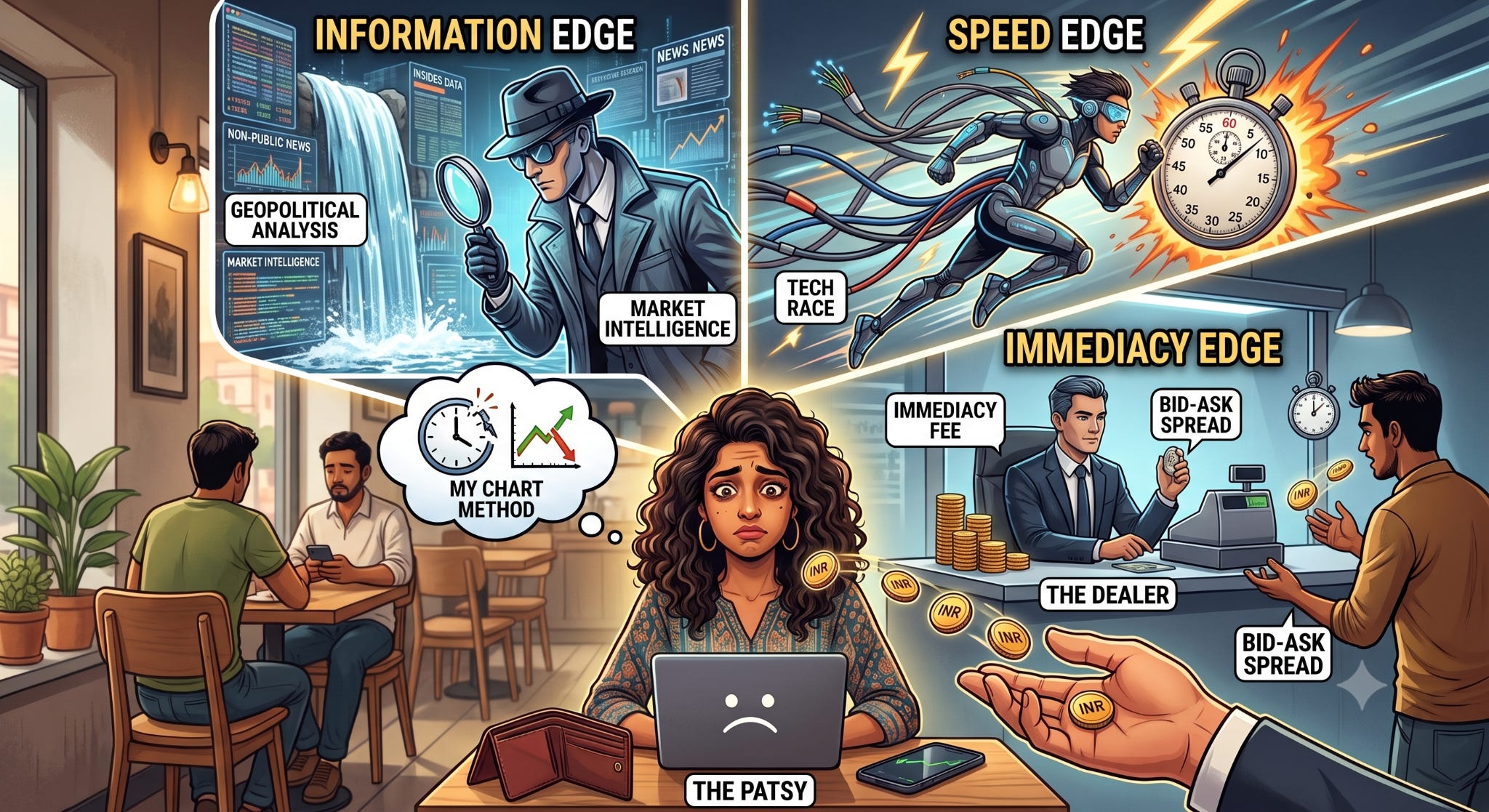
This brings us to the most tragic character in the market: the Futile Trader. These folks enter the arena to extract profits. They watch a few videos, draw some lines on a chart, and assume they possess a winning strategy. But their edge does not exist. They step into the ring with zero superpowers and get beaten by the true predators. Remember our casino analogy? They are the patsy.
Dear readers, do you have an edge? The nagging truth is this: all edges are temporary. Even the most profitable apex predator with discernable edge loses sleep over this inconvenience. But why this inconvenience? Having a profitable trading strategy is like discovering a hidden, stocked fishing hole. At first, the lone fisherman pulls out massive catches with zero competition. But success leaves footprints. Soon, other boats notice the heavy nets and swarm the quiet spot. The fishes vanish, the strategy stops working. The fishermen pack up and search for new waters.
Let me complete the nagging truth - While all edges are temporary, the philosophy is permanent.

Your Secret Weapon (Why the Underdog Can Win)
It is easy to feel outgunned by massive institutions - the whales and sharks of the Ocean. But, let me tell you a secret: these players have a chink in the armor. Sometimes they get trapped. Hedge funds take on leverage to increase the absolute profits of their trades. Pooled funds who invest other people’s money rely on their investors staying invested, but they can’t force this. When the market drops, brokers issue margin calls and panicked clients demand their cash back. These professionals are forced to act, to their own detriment. This brings us to our philosophy: The Best Bargains Are Made When Your Counterparty Is Being FORCED TO SELL.
This forced panic is where you hold the trump card: the luxury of choice. If you invest using your own cash, you possess permanent capital. No broker can force you to sell your portfolio at the bottom. You have no career risk, no angry board of directors. And an infinite time horizon. You can afford to look ten or twenty years into the future while a stressed fund manager sweats over a bad month.
Let me reiterate - the best buys come from forced sellers. Just look at Warren Buffett during the 2008 financial crisis. While major institutions suffered fire-sale liquidations, the usual buyers vanished. Buffett stepped in as the ultimate informed value trader. He did not use secret algorithms. He used his edge of permanent capital to buy fantastic assets from desperate sellers. He bought when others were forced to sell.
You do not need a supercomputer to win. You need the freedom to stand your ground when the professionals start to panic. Your superpower is TIME.
Know Thyself (and Enjoy Your Coffee)
The market is an ecosystem that forces you to choose your role. If you refuse to choose, the market chooses it for you - often as the patsy futile trader or the lucky idiot. Understanding the archetypes dictates how you survive and thrive in it. You do not need giant machines or intrinsic valuation skills to succeed. You just need to know yourself and your motives.
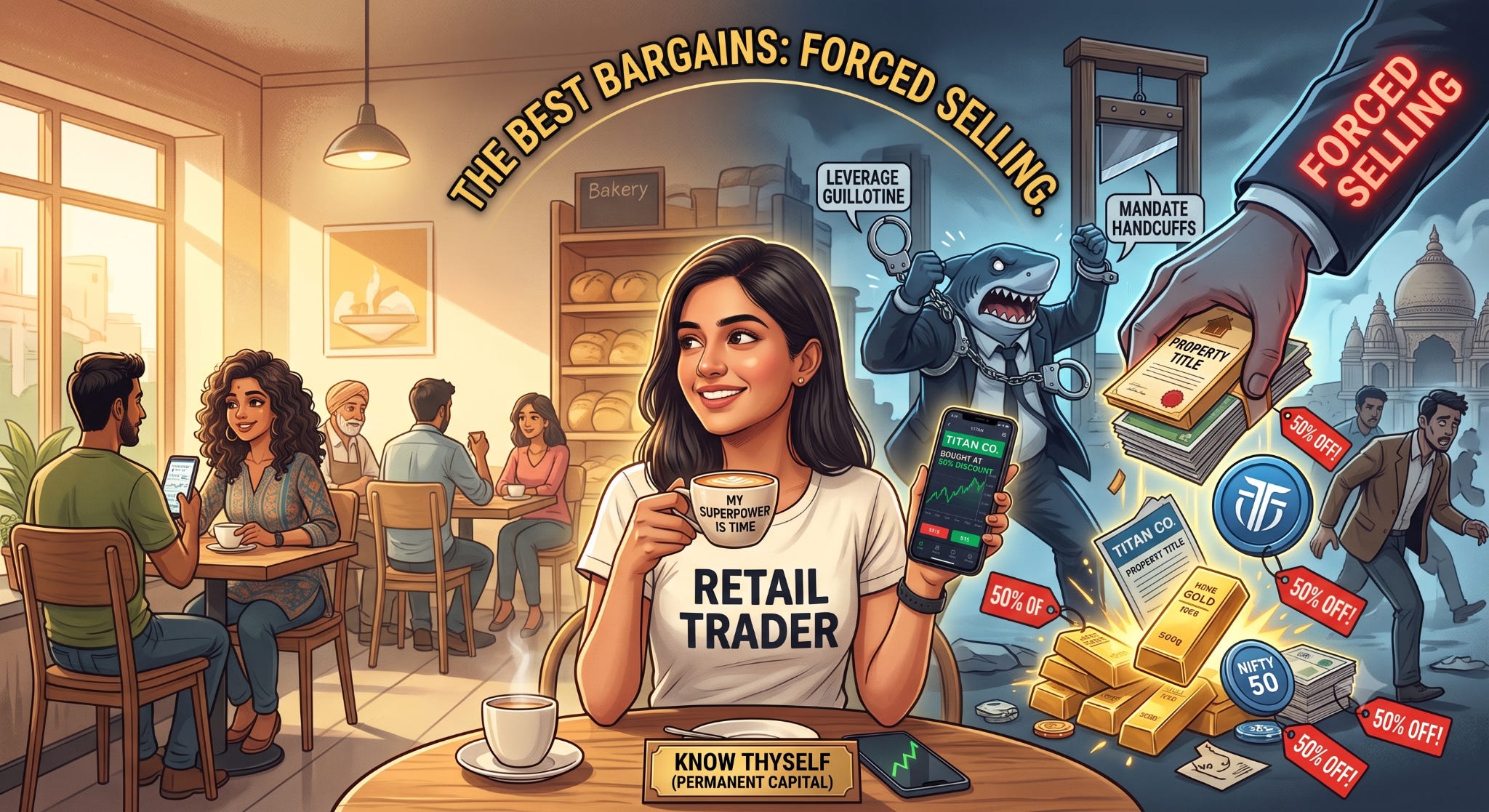
So embrace your true identity in the market. You possess the structural freedom to stand your ground when the professionals panic. Sip your coffee, watch the chaos from a safe distance, and let the sharks fight each other for the scraps.
Want to dive deeper into these concepts?
I’ve recorded a comprehensive, hour-long video episode that explores all of these topics in greater detail, as part of an ongoing course. Click here to watch the full deep-dive on YouTube and continue your learning journey: